 Aerogen Panel · Day 2
Aerogen Panel · Day 2
Aerogen Panel · Day 2
A mature project as a benchmark for what we are building together. Same methodology, different phase.
A 45-day average waitlist target imposed across the region. The manager has the goal on the table — but no dashboard to know, month by month, which services are failing or how far off they are.
Without data, the question gets answered by hierarchy or by intuition. That means asking for resources you might not need — or coping with less, thinking it is a planning issue. The manager cannot argue either case.
The waitlist is a stock. Bringing it down means touching one of two valves — how many patients come in, how many go out. The panel was built to see, measure and act on both.
Patient flow, historical KPIs, drill-down by service or procedure. The instrument that finally puts the ceiling and the current position on the same screen.
Algorithm-assisted monthly plan with real-time KPIs, auditable reasoning behind every assignment, and a signed-off PDF report. The manager's intuition does not disappear — it gains backing it can defend.
Daily efficiency map per operating room, suspensions with reasons, intervention-level detail. The question that used to be answered by seniority is now answered by data.
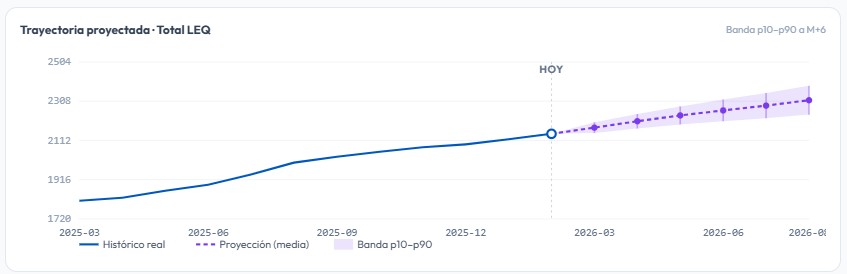
A stock-and-flow model projected forward. If today's inflow and outflow continue at the current rate, where is the list in three, six, twelve months? Test scenarios — opening an extra OR, reallocating capacity — before deciding.
Three indicators define the conversation: one regulatory, one operational, one strategic. The panel is built around moving them.
Share of patients within the legal waiting window. Political and legal exposure. The manager answers for this number every single month — with nowhere to hide it.
Direct cost. Friction with clinicians. Visibility outward. The fine operational signal that does not appear in reports but everyone in the block feels.
If more patients come in than go out, a future problem is guaranteed. This index says so before the average delay does — and the simulator projects it forward.
The hospital no longer buys devices alone. It buys help moving its scoreboard. Product alone competes on price. Whoever brings data, tools and evidence becomes a partner — invited into the conversation, not just to the purchase order.
These are the KPIs in surgery. In respiratory care — the manager has his own.
The ventilation projects you saw earlier and the surgical panel you just saw are not different things. They are different stages of the same model. Same hands. Same methodology. Same KPIs as criteria.